Official feasts used to be an important part of the human community. People would gather together to remember something sacred, express their faith and hope for the future, and / or just be together formally, recognizing each other as being part of a shared community. Few things express a desire for shared companionship and social intimacy more than dining together. Sadly, the gathering together for feasting is increasingly a relic of the past – at least here in the West.
It need not be so! Today we will remember the ancient feasts.
The Feast Day of St. Monica
The Feast Day of St. Monica is a Christian religious feast day honoring Monica, an early North African Christian saint and the mother of St. Augustine of Hippo. She is honored for her virtues, particularly her suffering as a result of her husband’s adultery. She is primarily associated with tears and is the patron saint of a large number of things, including married women; difficult marriages; disappointing children; victims of adultery or unfaithfulness; victims of (verbal) abuse; and conversion of relatives; alcoholics; Berbers, and Lapsed Catholics.
Monica (c. 332 – 387) was an early North African Christiansaint and the mother of Augustine of Hippo. She is remembered and honored in the Catholic and Orthodox Churches, albeit on different feast days, for her outstanding Christian virtues, particularly the suffering caused by her husband’s adultery, and her prayerful life dedicated to the reformation of her son, who wrote extensively of her pious acts and life with her in his Confessions. Popular Christian legends recall Monica weeping every night for her son Augustine.
Life
Monica is assumed to have been born in Thagaste (present-day Souk Ahras, Algeria). She is believed to have been a Berber on the basis of her name. She was married early in life to Patricius, a decurion pagan, in Thagaste. Patricius reportedly had a violent temper and appears to have been of dissolute habits; apparently his mother exhibited similar behaviours. Monica’s almsgiving, deeds and prayer habits annoyed Patricius, but it is said that he always held her in respect.
Monica had three children who survived infancy: two sons, Augustine and Navigius, and a daughter, ‘Perpetua’ of Hippo. Unable to secure baptism for them, she grieved heavily when Augustine fell ill. In her distress she asked Patricius to allow Augustine to be baptized; he agreed, then withdrew this consent when the boy recovered.
But Monica’s relief at Augustine’s recovery turned to anxiety as he misspent his renewed life being wayward and, as he himself says, lazy. He was finally sent to school at Madauros. He was 17 and studying rhetoric in Carthage when Patricius died.
Augustine had become a Manichaean at Carthage. When, upon his return home, he shared his views regarding Manichaeism, Monica drove him away from her table. However, she is said to have experienced a vision that convinced her to reconcile with him.
Saint Augustine and his mother, Saint Monica, by Ary Scheffer (painting from 1846)
At this time she visited a certain (unnamed) bishop who consoled her with the words, “the child of those tears shall never perish.” Monica followed her wayward son to Rome, where he had gone secretly; when she arrived he had already gone to Milan, but she followed him again. Here she found Ambrose and through him she ultimately saw Augustine convert to Christianity after 17 years of resistance.
In his book Confessions, Augustine wrote of a peculiar practice of his mother in which she “brought to certain oratories, erected in the memory of the saints, offerings of porridge, bread, water and wine.” When she moved to Milan, the bishop Ambrose forbade her to use the offering of wine, since “it might be an occasion of gluttony for those who were already given to drink”. So, Augustine wrote of her:
In place of a basket filled with fruits of the earth, she had learned to bring to the oratories of the martyrs a heart full of purer petitions, and to give all that she could to the poor – so that the communion of the Lord’s body might be rightly celebrated in those places where, after the example of his passion, the martyrs had been sacrificed and crowned.
— Confessions 6.2.2
Monica and her son spent six peaceful months at Rus Cassiciacum (present-day Cassago Brianza) after which Augustine was baptized by Ambrose in the church of St John the Baptist at Milan. Monica and Augustine left for Africa and they set out on their journey, stopping at Civitavecchia and at Ostia. Here Monica died, and Augustine’s grief inspired his Confessions.
What do you eat to celebrate the Feast Day of St. Monica?
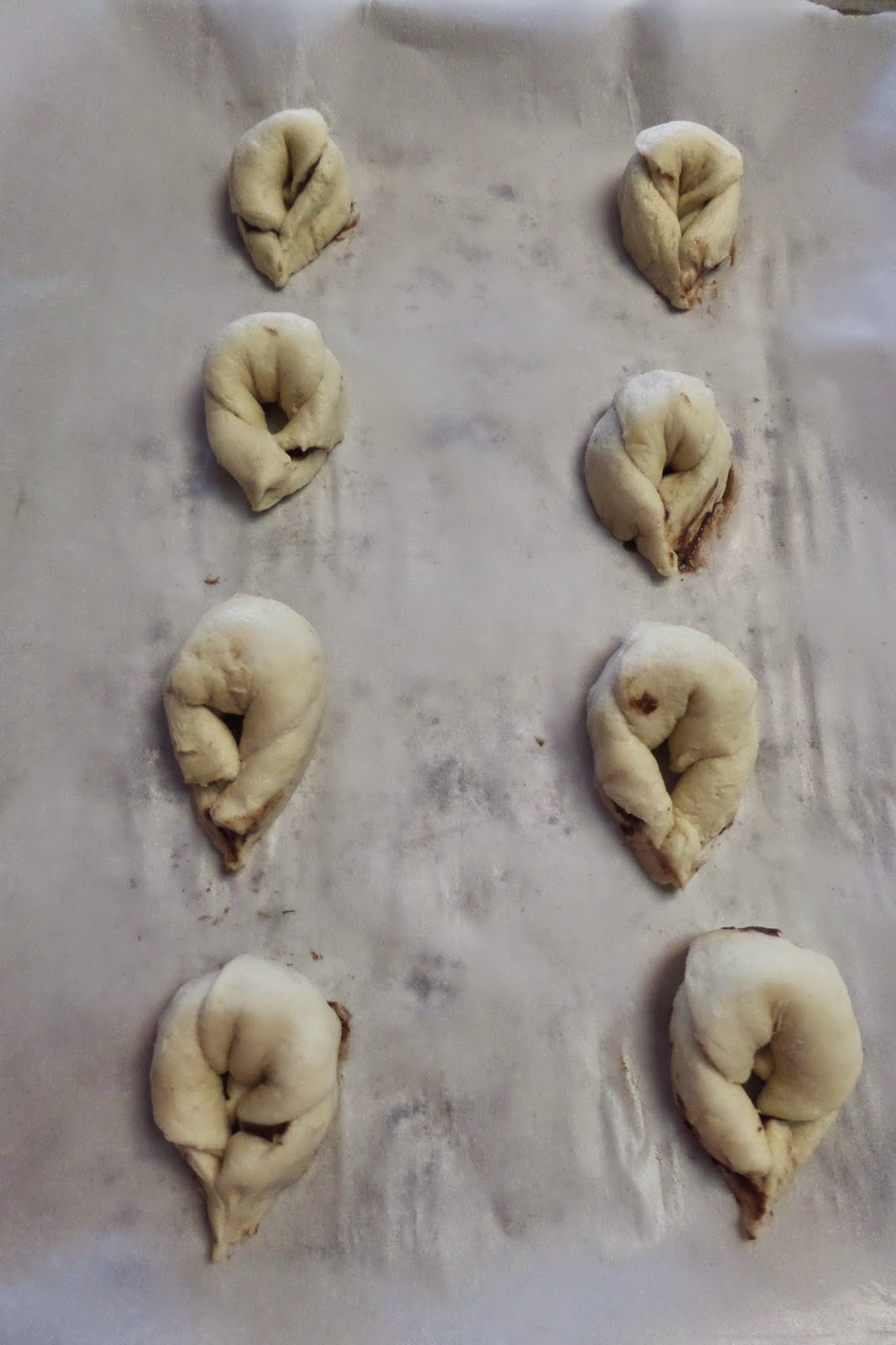
St. Monica is famous for her tears, particularly over her marriage and her desire to see her children become believers. As a result, I have found a recipe to celebrate her feast day themed to her life:
1. Break apart crescent dough into triangles. 2. Spread a small amount (approx. 1-2 teaspoons) of Nutella or favorite spread on the top end of the triangle only. A little bit goes a long way…Otherwise the chocolate will leak all over! 3. Pinch the ends together to increase the chances of holding the teardrop shape.
Here are before and after photos.
Remember that the dough will rise/puff up a little bit so try to elongate the ends as much as possible.
What is a prayer you can say on St. Monica’s Feast Day?
Dear St. Monica, model of patience and perseverance, you never gave up on your Augustine, your son, as he meandered away from God and into a life of sin. Pray that we may remember that at times, we’ve all turned away from God. Ask God to bless us with a fraction of your patience, that we may bask in the fullness of joy that the love of God offers us. Through your intercession we ask God to watch over all mothers and heal, strengthen and bless the relationships they share with their children. In Jesus’s name we pray. Amen.
When is the Feast Day of St. Monica celebrated?
The Feast Day of St. Monica is celebrated 27 August (Latin Church, Church of England, Lutheran Church–Missouri Synod) AND 4 May (pre-1969 General Roman Calendar, Eastern Orthodox Church, Eastern Catholic Churches, Evangelical Lutheran Church in America, Episcopal Church in the United States of America)
I hope everyone who celebrates has a wonderful day!