


My book reviews include full spoilers. To see other books I’ve reviewed, please click HERE.


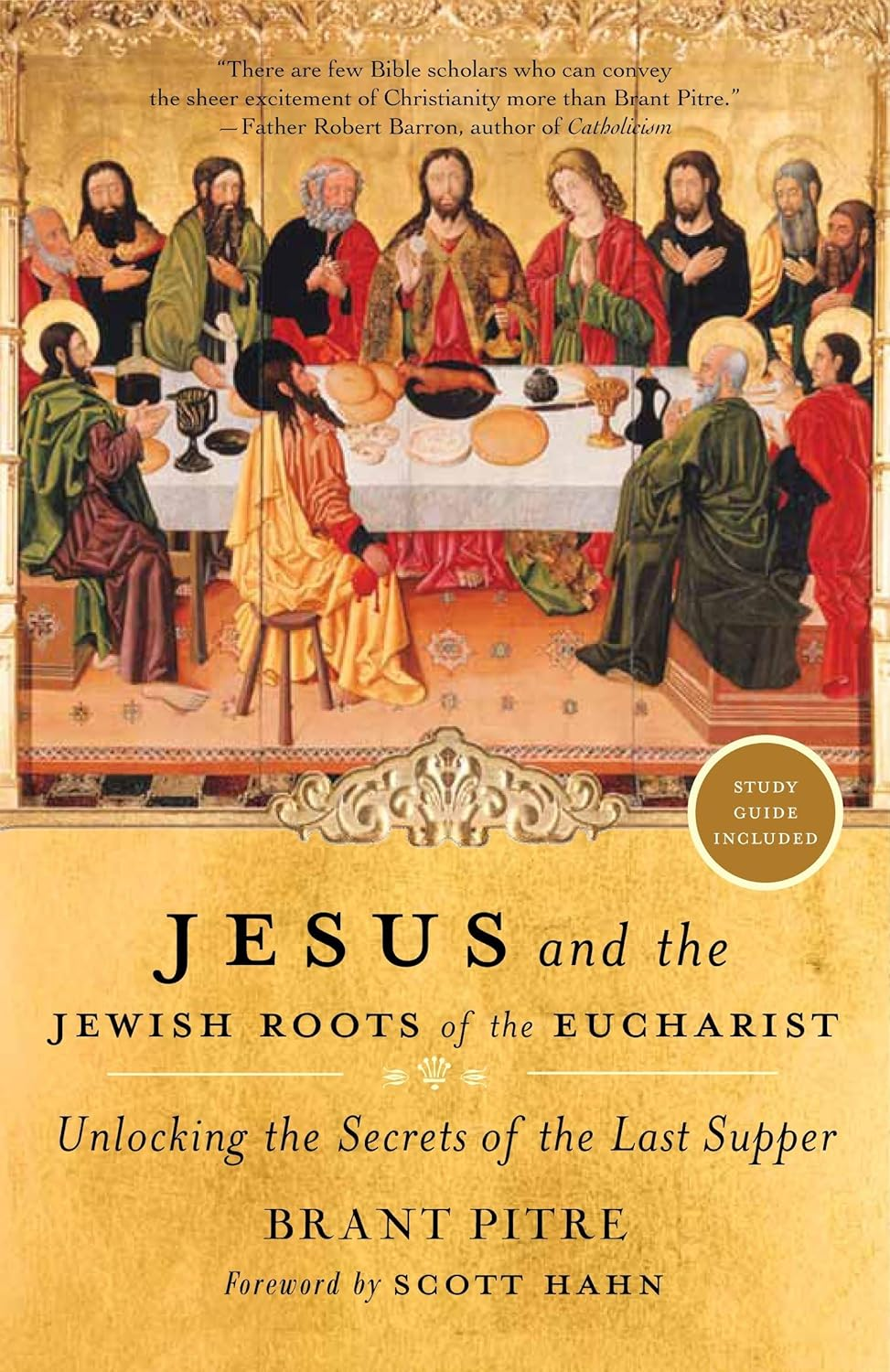
Title: Jesus and the Jewish Roots of the Eucharist: Unlocking the Secrets of the Last Supper
Author: Brant Pitre
Copyright Date: February 2, 2016
Audio Publisher: Mission Audio (2017)
Narrated by: David Cochran Heath
Pages: 256
Audio length: 6 hours, 13 minutes
SUMMARY:
via Amazon
In recent years, Christians everywhere are rediscovering the Jewish roots of their faith. Every year at Easter time, many believers now celebrate Passover meals (known as Seders) seeking to understand exactly what happened at Jesus’ final Passover, the night before he was crucified. Jesus and the Jewish Roots of the Eucharist shines fresh light on the Last Supper by looking at it through Jewish eyes. Using his in-depth knowledge of the Bible and ancient Judaism, Dr. Brant Pitre answers questions such as:
- What were the Jewish hopes for the Messiah?
- What was Jesus’ purpose in instituting the Eucharist during the feast of Passover?
- And, most important of all, what did Jesus mean when he said, “This is my body…This is my blood”?
To answer these questions, Pitre explores ancient Jewish beliefs about the Passover of the Messiah, the miraculous manna from heaven, and the mysterious Bread of the Presence. As he shows, these three keys – the Passover, the manna, and the Bread of the Presence – have the power to unlock the original meaning of the Eucharistic words of Jesus. Along the way, Pitre also explains how Jesus united the Last Supper to his death on Good Friday and his Resurrection on Easter Sunday.
Inspiring and informative, Jesus and the Jewish Roots of the Eucharist is a groundbreaking work that is sure to illuminate one of the greatest mysteries of the Christian faith: the mystery of Jesus’ presence in “the breaking of the bread”.
My Review:
Have you ever read the Gospel of John and felt challenged by it? If so, you’re not alone. As the text recounts, a large number of people were challenged by this text even at the time.
John 6: 52 The Jews then disputed among themselves, saying, “How can this man give us his flesh to eat?” 53 So Jesus said to them, “Truly, truly, I say to you, unless you eat the flesh of the Son of Man and drink his blood, you have no life in you. 54 Whoever feeds on my flesh and drinks my blood has eternal life, and I will raise him up on the last day. 55 For my flesh is true food, and my blood is true drink. 56 Whoever feeds on my flesh and drinks my blood abides in me, and I in him. 57 As the living Father sent me, and I live because of the Father, so whoever feeds on me, he also will live because of me. 58 This is the bread that came down from heaven, not like the bread the fathers ate, and died. Whoever feeds on this bread will live forever.” 59 Jesus said these things in the synagogue, as he taught at Capernaum.
60 When many of his disciples heard it, they said, “This is a hard saying; who can listen to it?”
In this book, Dr. Pitre attempts to explain this hard teaching, and as I am a bit of a Bible Nerd TM, I thoroughly enjoyed it. The Eucharist, also often referred to as Holy Communion, is foundational to Christianity. If you are a Christian, there may be nothing more important to your faith. With that being the case, you should try to understand it as best as you can. Dr. Pitre’s scholarship opened up and expanded my understanding of a topic that I thought I knew relatively well – The Last Supper – and demonstrated that there are several additional layers of meaning within the Gospel texts that I had previously missed. He makes a very strong textual case for the Catholic and Orthodox teaching regarding the literal presence of Jesus in the Christian practice of Holy Communion, using the New Testament accounts of the Last Supper, the Crucifixion, the Exodus account of manna from Heaven, the Old Testament descriptions of “the Bread of the Presence,” as well as extra-Biblical information derived from the Jewish Targums, Mishnah, and secular historical records. Whether you ultimately end up agreeing with Dr. Pitre’s textual arguments, it is likely if you are not a Bible Scholar that you have never heard them made before.
I don’t want to spoil too much of the textual exegeses here, as that would largely just be repeating the book itself, however, there were a couple of things from within the book that I found *particularly* new and interesting.
First, I had never given much thought to the various Old Testament mentions of ‘The Bread of the Presence.’
““““““““““
Exodus 25: 8 And let them make me a sanctuary, that I may dwell in their midst. 9 Exactly as I show you concerning the pattern of the tabernacle, and of all its furniture, so you shall make it. […] 23 “You shall make a table of acacia wood. Two cubits shall be its length, a cubit its breadth, and a cubit and a half its height. 24 You shall overlay it with pure gold and make a molding of gold around it. 25 And you shall make a rim around it a handbreadth wide, and a molding of gold around the rim. 26 And you shall make for it four rings of gold, and fasten the rings to the four corners at its four legs. 27 Close to the frame the rings shall lie, as holders for the poles to carry the table. 28 You shall make the poles of acacia wood, and overlay them with gold, and the table shall be carried with these. 29 And you shall make its plates and dishes for incense, and its flagons and bowls with which to pour drink offerings; you shall make them of pure gold. 30 And you shall set the bread of the Presence on the table before me regularly.
1 Samuel 21: And David said to Ahimelech the priest, “The king has charged me with a matter and said to me, ‘Let no one know anything of the matter about which I send you, and with which I have charged you.’ I have made an appointment with the young men for such and such a place. 3 Now then, what do you have on hand? Give me five loaves of bread, or whatever is here.” 4 And the priest answered David, “I have no common bread on hand, but there is holy bread—if the young men have kept themselves from women.” 5 And David answered the priest, “Truly women have been kept from us as always when I go on an expedition. The vessels of the young men are holy even when it is an ordinary journey. How much more today will their vessels be holy?” 6 So the priest gave him the holy bread, for there was no bread there but the bread of the Presence, which is removed from before the Lord, to be replaced by hot bread on the day it is taken away.
Pitre’s book links this bread with the person of Jesus Christ (as well as providing a fascinating explanation for why it was lawful for David who was not a Levite and his men to eat the bread.)
““““““““““
Another new to me and completely fascinating aspect of the text was Pitre’s interpretation of the Last Supper, using ancient Jewish Passover traditions as a guide to understanding what Jesus was doing in the text. Pitre explains that in a Jewish Passover dinner, the food was eaten in a particular sequence and that four glasses of wine are consumed as part of this religious tradition. Dipping the bread into the cup was thus done at a certain place within that ceremony – so that we know precisely when within the dinner that Judas left to betray Jesus. The text also makes a case – one that the earliest Christian disciples would have understood and picked up on – that Jesus did not actually finish the Passover dinner in the Upper Room. If you read closely, Jesus makes the following announcement during the dinner:
Matthew 26: 6 Now as they were eating, Jesus took bread, and after blessing it broke it and gave it to the disciples, and said, “Take, eat; this is my body.” 27 And he took a cup, and when he had given thanks he gave it to them, saying, “Drink of it, all of you, 28 for this is my blood of the covenant, which is poured out for many for the forgiveness of sins. 29 I tell you I will not drink again of this fruit of the vine until that day when I drink it new with you in my Father’s kingdom.”
It thus appears that Jesus did not actually finish the Passover at that time because he did not drink the 4th and final cup of wine. Pitre points out though that Jesus does eventually drink wine in this account, in the next chapter, just as He was completing His work on the cross.
Matthew 27: 48 And one of them at once ran and took a sponge, filled it with sour wine, and put it on a reed and gave it to him to drink.
Pitre makes the case that Passover and His Crucifixion were linked, in that Jesus was putting Himself into the place of the Passover lamb within the ceremony feast. If so, then that makes an even stronger case that His command to eat His flesh and drink His blood was literal. And Pitre’s interpretation provides a deeper purpose for these events that might otherwise seem strange or unfathomable to a reader, such as why Jesus had wine on the cross and why He drank it when He did. My account here in the review doesn’t do justice to the entire explanation, so I strongly encourage you to read through it for yourself. It’s fascinating.
In case you are wondering, the book also makes an argument for how this is possible and how it avoids being the very unlawful act of cannibalism. I will save that explanation for the work, though.
This book will be a challenge to a lot of Protestant readers who view Holy Communion as a symbolic rather than literal event. At a minimum, what Pitre achieves is a text-based argument for transubstantiation. If you disagree with his conclusions, you at least have to admit it’s a text-based disagreement, and not one where the interpretation was entirely pagan in origin. For that alone, the book is a remarkable achievement as it helps the disparate parts of the Christian world to take steps toward unity rather than hatred and division. Alternatively though, the book might challenge you as a Protestant to reconsider your position on the topic entirely.
Overall, though the material is dense, I found this to be a very easy book to read and I was able to get through it all in a single day – though I absolutely have plans to revisit it many times. Pitre is a gifted scholar and communicator and that comes through in his writing. I thoroughly recommend it to everyone interested in a text-based interpretation of the subject matter.