


Full spoilers for the entire book below. Proceed with caution.
For other book reviews, click HERE:


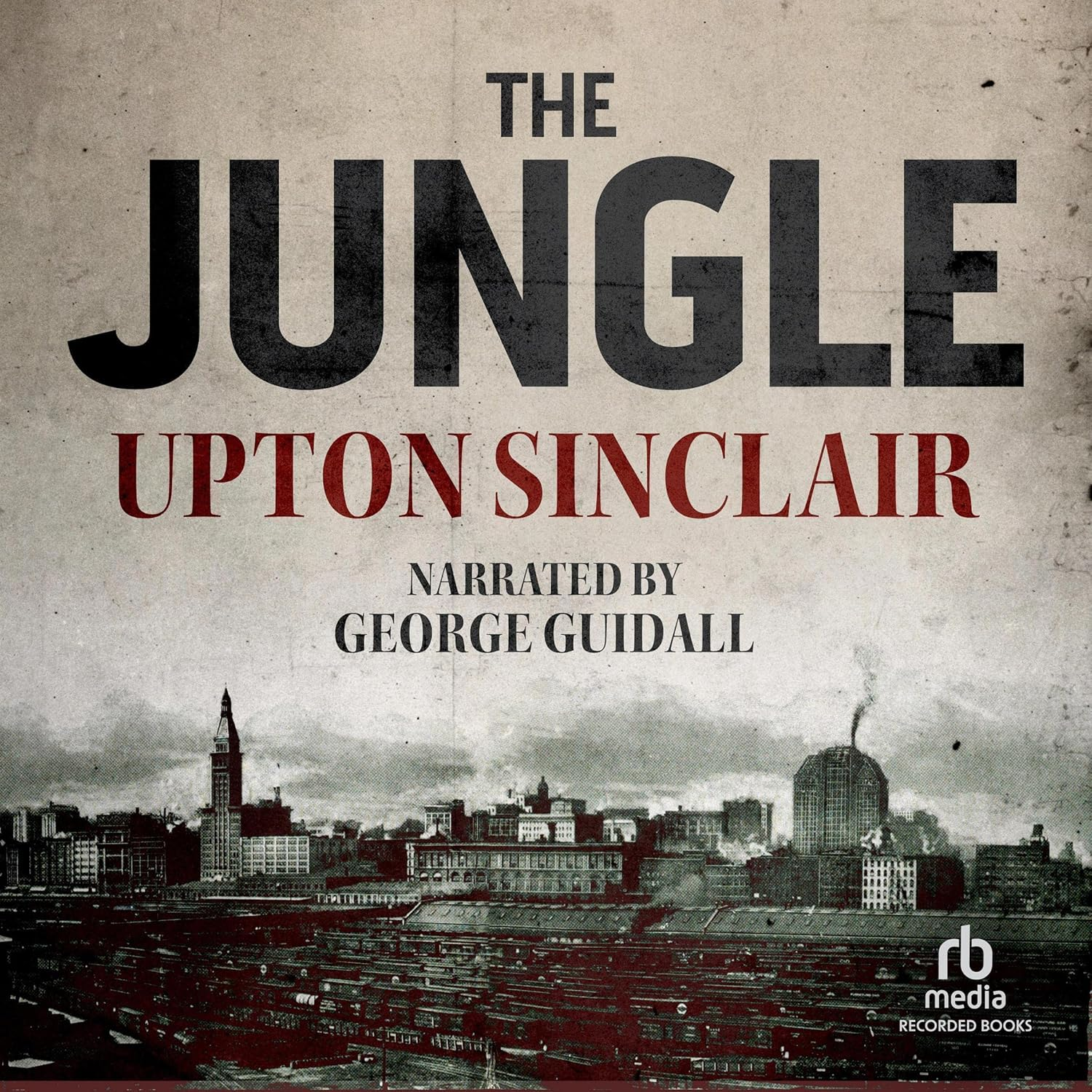
Title: The Jungle
Author: Upton Sinclair
Publication Date: 1906 (novel), 1994 (audio)
Publisher: Recorded Books, L.L.C.
Narrated By: George Guidall
Recording time: 15 hrs and 58 mins
THE PLOT
via wiki:
Jurgis Rudkus marries his sweetheart, Ona Lukoszaite, in a joyous traditional Lithuanian wedding feast. They and their extended family have recently immigrated to Chicago due to financial hardship in Lithuania, then part of the Russian Empire. They have heard that America offers freedom and higher wages and have come to pursue the American Dream.
Despite having lost much of their savings being conned on the trip to Chicago, and then having to pay for the wedding—and despite the disappointment of arriving at a crowded boarding house—Jurgis is initially optimistic about his prospects in Chicago. Young and strong, he believes that he is immune to the misfortunes that have befallen others in the crowd. He is swiftly hired by a meatpacking factory; he marvels at its efficiency, even while witnessing the cruel treatment of the animals.
The women of the family answer an ad for a four-room house. Ona, who came from an educated background, figures that they could easily afford it with the jobs that Jurgis, proud Marija, and ambitious Jonas have gotten. While they discover at the showing that the neighborhood is unkempt and the house doesn’t live up to the advertisement, they are taken in by the slickness and fluent Lithuanian of the real estate agent and sign a contract for the house.
However, with the help of an old Lithuanian neighbor, they discover several unexpected expenses in the contract that they must pay every month on time, or else face eviction—the fate of most home buyers in the neighborhood. To meet these costs, Ona and thirteen-year-old Stanislovas (whom the family had wished to send to school) must take up work as well.
While sickness befalls them often, they cannot afford not to work. That winter, Jurgis’s father, weakened by exposure to chemicals and the elements at his job, dies of illness.
Some levity is brought to their lives by the arrival of a musician, named Tamoszius, who courts Marija, and the birth of Jurgis and Ona’s first child. However, this happiness is tempered when Ona must return to work one week after giving birth, and Marija is laid off in a seasonal cutback. Jurgis attends union meetings passionately; he realizes that he had been taken in by a vote-buying scheme when he was new to Chicago, learns that the meat factories deliberately use diseased meat, and furthermore that workers frequently come down with ailments related to their dangerous and unsanitary work.
Work becomes more demanding as wages fall; the working members of the family suffer a series of injuries. Amid this hardship, Jonas deserts the family, leaving them no choice but to send two children to work as newspaper boys. The youngest child, a handicapped toddler, dies of food poisoning; only his mother grieves his death.
After recovering from his injury, Jurgis takes the least desirable job at a fertilizer mill. In misery, he begins drinking alcohol. He becomes suspicious of his pregnant wife’s failure to return home on several nights. Ona eventually confesses that her boss, Phil Connor raped her, after which, by threatening to fire and blacklist everyone in her family, he managed to coerce her into a continuing sexual relationship.
Jurgis furiously attacks Connor at his factory, but half a dozen men tear him away. While in prison awaiting trial, he realizes it is Christmas Eve. The next day, his cellmate, Jack Duane, tells him about his criminal ventures and gives him his address. At trial, Connor testifies that he had fired Ona for “impudence” and easily denies Jurgis’s account; the judge dismissively sentences Jurgis to thirty days in prison plus court fees.
Stanislovas visits Jurgis in prison and tells him of the family’s increasing destitution. After Jurgis serves his term (plus three days for his inability to pay the fees), he walks through the slush for an entire day to get home, only to find that the house had been remodeled and sold to another family. He learns from their old neighbor that, despite all of the sacrifices they had made, his family had been evicted and had returned to the boarding house.
Upon arriving at the boarding house, Jurgis heard Ona screaming. She is in premature labor, and Marija explains that the family had no money for a doctor. Jurgis convinces a midwife to assist, but it is too little too late; the infant is dead, and with one last look at Jurgis, Ona dies shortly afterward. The children return with a day’s wages; Jurgis spends all of it to get drunk for the night.
The next morning, Ona’s stepmother begs Jurgis to think of his surviving child. With his son in mind, he endeavors again to gain employment despite his blacklisting. For a time, the family gets by and Jurgis delights in his son’s first attempts at speech. One day, Jurgis arrives home to discover that his son had drowned after falling off a rotting boardwalk into the muddy streets. Without shedding a tear, he walks away from Chicago.
Jurgis wanders the countryside while the weather is warm, working, foraging, and stealing for food, shelter, and drink. In the fall, he returns to Chicago, sometimes employed, sometimes a tramp. While begging, he chances upon an eccentric rich drunk—the son of the owner of the first factory where Jurgis had worked—who entertains him for the night in his luxurious mansion and gives him a one-hundred-dollar bill (worth the equivalent of about $3,500 as of October 2024). Afterward, when Jurgis spends the bill at a bar, the bartender cheats him. Jurgis attacks the bartender and is sentenced to prison again, where he once again meets Jack Duane. This time, without a family to anchor him, Jurgis decides to fall in with him.
Jurgis helps Duane mug a well-off man; his split of the loot is worth over twenty times a day’s wages from his first job. Though his conscience is pricked by learning of the man’s injuries in the next day’s papers, he justifies it to himself as necessary in a “dog-eat-dog” world. Jurgis then navigates the world of crime; he learns that this includes a substantial corruption of the police department. He becomes a vote fixer for a wealthy political powerhouse, Mike Scully, and arranges for many new Slavic immigrants to vote according to Scully’s wishes—as Jurgis once had. To influence those men, he had taken a job at a factory, which he continues as a strikebreaker. One night, by chance, he runs into Connor, whom he attacks again. Afterward, he discovers that his buddies cannot fix the trial as Connor is an important figure under Scully. With the help of a friend, he posts and skips bail.
With no other options, Jurgis returns to begging and chances upon a woman who had been a guest to his wedding. She tells him where to find Marija, and Jurgis heads to the address to find that it is a brothel being raided by the police. Marija tells him that she was forced to prostitute herself to feed the children after they had gotten sick, and Stanislovas—who had drunk too much and passed out at work—had been eaten by rats. After their speedy trial and release, Marija tells Jurgis that she cannot leave the brothel as she cannot save money and has become addicted to heroin, as is typical in the brothel’s human trafficking.
Marija has a customer, so Jurgis leaves and finds a political meeting for a warm place to stay. He begins to nod off. A refined lady gently rouses him, saying, “If you would try to listen, comrade, perhaps you would be interested.” Startled by her kindness and fascinated by her passion, he listens to the thundering speaker. Enraptured by his speech, Jurgis seeks out the orator afterward. The orator asks if he is interested in socialism.
A Polish socialist takes him into his home, conversing with him about his life and socialism. Jurgis returns home to Ona’s stepmother and passionately converts her to socialism; she placatingly goes along with it only because it seems to motivate him to find work. He finds work in a small hotel that turns out to be run by a state organizer of the Socialist Party. Jurgis passionately dedicates his life to the cause of socialism.
My Review
Before I picked this up, The Jungle lived in my mind as a reminder that unchecked greed and a lack of regulations might lead bad corporate actors to not exactly care how our food was made , whether it was clean, or whether the conditions for the people doing the work were safe and sanitary.
It’s comforting to live a century later where our food industry has lots of regulations, and has successfully checked that greedy human impulse to make as much money as possible, poison the customers, and have the work done under such unsafe and underpaid conditions that our country has to import tens of millions of “disposable” people from abroad to keep the conveyor belts moving.


Okay, I’m back. I thought about grabbing a human-flavored hot dog while I was up, but I’ll save one of those for later.
There are aspects of this book that will feel hauntingly familiar to a modern reader. As they say, history may not repeat, but it certainly seems to rhyme. Sinclair’s story touches on and is most well-remembered for its description of a corrupt meatpacking industry, but it’s more than that. It’s a broad critique of capitalism, immigration, wage slavery, and the lack of regulation and social safety nets. Our protagonist goes from one bad job to increasingly worse jobs, and then to jail and homelessness, before getting involved with organized crime. He learns that organized crime works alongside business, politicians, and labor unions to control and protect the system that ruined his own life. Eventually he is tossed out of his upwardly mobile life of crime after getting into a fight with someone who has “more pull” than he does in the crime world. Destitute once more, he discovers the socialist party as the book ends.
The book presents the Socialists as the long-sought truly good alternative to the wretched hive of scum and villainy that is early 20th century Chicago. And there, with that abrupt shift to hope and optimism, The Jungle ends.
“Chicago will be ours! Chicago will be ours!”
After living through so many tragedies with Jurgis, as a Reader, you sort of expect Sinclair to eventually write a sequel wherein we learn that the Socialist Party was also filled with bad actors, too. The point of the first 90% of the book seems to be “human nature when combined with wealth and power is wicked and cruel, thus the systems we live in are wicked and cruel” but at the end, we learn that the actual point was to say that, yes, but also to carve out a human nature exception for our saviors the holy socialists.
It’s a good thing we don’t have a subsequent century of attempts at the socialist utopia spectacularly failing because the optimists are always wrong about themselves. To be fair to Sinclair, this book was published before that subsequent century occurred.
The backstory of The Jungle is pretty interesting. Sinclair got a job at a meatpacking plant in Chicago and worked there for seven weeks gathering information about how the work is done, the conditions of the plants, and the treatment of the employees. He then published this book serially in the socialist newspaper, Appeal to Reason, before publishing the novel as a combined whole in 1906. The work had a significant impact on public awareness of meatpacking industry conditions and the outcry that followed The Jungle‘s publication led to sanitation reforms and other product safety inspection legislation. Jack London described Sinclair’s novel as the Uncle Tom’s Cabin of wage slavery.
(I note with the benefit of hindsight that if the public had actually internalized the deeper message of the novel, they would have anticipated that these new sanitation measures would include paid-off inspectors, corner-cutting, graft, and all manner of crime and corruption. But the alternative to a certain delusional amount of trust in in the food industry is what… living agrarian lives and doing all of the work of food gathering and production oneself?)
On a human level, this book was very well written but deeply painful and difficult to read. The amount of realistic misery inflicted upon poor Jurgis is hard to get through. He is slowly crushed by financial obligations, small and large betrayals, and his heavy and unsanitary workload. His wife is forced to leave the house and work to pay their bills, and there she is r*ped by her boss. When Jurgis confronts and attacks the man after finding out that this happened, he goes to jail, isn’t around to make payments on their unaffordable house, and then in his absence the family loses said house. The women in his life eventually work in brothels and his wife eventually dies. His son dies. Every time something positive happens, it is immediately undercut by something worse and negative.
One thing I asked myself, while reading, is whether society should ask high schoolers and college aged students to read the book? It’s already happening. Most of us, if we’ve ever sat down to read this book, had it assigned to us by a teacher. I don’t know if I settled on an answer to my question. The book is intended to change the way a person views the world. I see the value in cultivating a certain amount of cynicism in the young. Cynical people are more difficult to manipulate than wide-eyed, inexperienced, trusting, optimists. On the other hand, the book is unabashedly Socialist Party propaganda. Is it a good idea to put it in the hands of young people and assume they won’t be taken in by the last couple of chapters? Despite its age, this book is timely and the fact that many of its concerns from a century ago are the same problems we still face today is jarring. Pointing out that there is a common relationship between money and corruption, crime and government, and how those things might operate within a democratic and capitalism-based society is useful and wise. On the other hand, suggesting that Socialism is a panacea for human nature, somehow immune to all of the same problems of capitalism and worse besides, is delusional.
I don’t have a good answer regarding the kids, but as for myself, I am glad I read the book. Sinclair is a great writer, even if his subject matter is grim and his ultimate conclusion is objectionable. The Jungle makes a compelling, though unwitting, argument that if society has been struggling with a similar fight against similar forms of evil and corruption, for a century, maybe we should try to come up with dramatically different answers than the ones we found 100 years ago lest we risk another century of the same outcomes. The challenge of the book is deciding what those new answers might be. It’s worth the read to start making those moral and social considerations.
Have you read The Jungle? If so, what did you think?