


This review includes full spoilers. Proceed accordingly. For other movie reviews from me, click HERE:
Dusty: [responding to a negative comment, just happy to have the post engagement]
“You got nothing, kiddo. Snake eyes. The house wins.”
Rating: R
Directors: Brian Palma
Writers: Brian Palma, David Koepp
Stars: Nicolas Cage, Gary Sinise, Carla Gugino
Release Date: August 7, 1998 (United States)
Run time: 1 hour, 38 minutes
THE PLOT:
via wiki:
During a tropical storm, corrupt Atlantic City police detective Rick Santoro attends a boxing match at the soon-to-close local arena between heavyweight champion Lincoln Tyler and challenger Jose Pacifico Ruiz. He meets up with his best friend since childhood, U.S. Navy Commander Kevin Dunne, who is escorting Defense Secretary Charles Kirkland and Arena director Gilbert Powell at the fight after a trip to Norfolk, Virginia.
As the first round begins, Kevin notices redhead Serena who wears a ruby ring; he leaves his seat which is then taken by Julia Costello, a platinum blonde in a white satin suit. When Ruiz unexpectedly knocks out Tyler, gunshots ring out, mortally wounding Kirkland and grazing Julia, who loses her blonde wig, revealing her naturally dark hair. Kevin kills the sniper and orders the arena to be locked down. Julia escapes into the casino.
Rick notices the supposedly knocked-out Tyler awoke at the sound of shots, and studies the fight tape which reveals the knockout punch didn’t connect. Tyler confesses he threw the fight to pay gambling debts. Serena paid him to take a dive. Suspecting a conspiracy, Rick reveals everything he has learned to Kevin, who says the Norfolk trip was to test the AirGuard missile defense system, which Powell’s company is backing. He deduces that the sniper, Palestinian terrorist Tarik Ben Rabat, assassinated Kirkland over the Pentagon’s defense cooperation with Israel.
Rick studies surveillance footage to find Serena and Zeitz while Kevin searches for Julia, aided by Powell’s security guards. Kevin is actually the conspiracy mastermind. He kills Serena and Zeitz and enlists Tyler.
Julia seduces a hotel guest so she can hide in his room. Rick finds her and takes her into protective custody. Julia confesses she is an analyst and had discovered the AirGuard test results were faked. She had tipped off Kirkland, but Kevin discovered her actions and arranged the conspiracy to kill her and Kirkland. After hiding Julia in a warehouse, Rick finds footage proving Kevin’s guilt.
Kevin confesses to Rick, saying his motive was to prevent further attacks on U.S. ships, like one in which Kevin had had to leave 28 men to drown. He offers Rick one million dollars for Julia’s location. When Rick refuses Kevin has Tyler beat him up, then plants a tracker on Rick and follows him to the warehouse just as Hurricane Jezebel hits. Rick uses a large wave as cover to rush Julia outside, where the police witness Kevin opening fire. Despite his protests that Julia is a suspect, Kevin goes around the corner and shoots himself, committing suicide on live network television.
Rick is hailed as a hero, but the press uncover his corruption and he loses his job, mistress, and family. Before reporting for his prison term, Rick meets Julia. She thanks him, as Powell is scrapping the AirGuard. Rick promises to call her when he gets out in twelve to eighteen months. Serena’s ruby ring is seen embedded in a concrete pillar of the new Powell Millennium Arena.
My Review
Snake Eyes is an entertaining murder-mystery film, built around a political assassination that takes place in the crowd of an Atlantic City boxing match. Nicolas Cage plays Rick Santoro, a corrupt, adulterous, smarmy Atlantic City Cop who finds himself in a it of a chess match with the plot’s mastermind, his best friend, Commander Kevin Dunne. The film makes use of a lot of POV changes during flashback sequences, as well as the numerous surveillance devices that are on site at the casino. Predictably, the flawed but good guy Santoro prevails, though not without a lot of cost paid, and how we get there is satisfying.
Nicolas Cage gives a great performance. He’s perfectly believable as a sleazebag, fast-talking cop, who beneath all of that has a moral core and lines he won’t cross. Gary Sinise made a career out of playing hyper-intense military men, and he gives an awesome and layered villain performance here. You get a sense in the film that he genuinely felt like he was acting in the best interest of the public, despite the obvious evil of his actions. There’s a fine line between a vigilante and a villain. He sees his actions as being virtuous, in the sense that killing a few people right now will save countless – and much more innocent – lives later. Cage’s Santoro, on the other hand, doesn’t believe killing innocent people today is justified by the number of hypothetical innocent people who might be saved later.
Ultimately, for the audience, we are guided to take Santoro’s side. The whistleblower he is trying to save, in teh aftermath of the assassination is truly innocent, young, and naive about how the world works. In short, she’s likeable. Dunne’s story about hearing soldiers under his command die was compelling, but he undermined his moral position *with the audience* by showing so much disrespect to his best friend. Dunne did not respect Santoro as a cop – so much so that he manipulated events to put Santoro on the scene – and after Santoro finally got in his way, he disrespected him further by appealing to him as a corrupt man, via bribing him.
I really enjoyed the end of this film. In the aftermath, Santoro wasn’t a hero. He got investigated and will be going to prison for being a corrupt cop. The threats made by Dunne came to fruition. Before he went to prison, he talks to the whistleblower he saved. In that conversation, the audience isn’t sold some idea that this action will clean up the military industrial complex. Far from it. The young whistleblower, Julia Costello, tells him that things are changing and getting cleaned up but he clearly doesn’t buy it. He and the audience understand the the house always wins. The government still got rid of an anti-war populist from a cabinet level position. The missile defense money will undoubtedly just go somewhere else, not stop altogether. And the government gets to look like it is willing and capable of stopping rogue bad guys, rather than corruption being the entire system.
Cage’s Santoro sums it up well, when he’s talking to Costello just before the movie ends:
“You know they say, back two, three hundred years ago, pirates put phony lighthouses right out by those big rocks, right out there. Ships would set a course by the lights, crash on the rocks; then everybody’d go out and rob ’em blind. Only one thing’s changed since then: lights are brighter.”
Santoro’s motivations ended up being even more heroic, with this outlook. He didn’t do the right thing because he’d be rewarded, or because it would change the world for the better in some obvious way. He ends up in prison and doesn’t believe much at all will change in the big picture. So why not take the bribe? He valued the life of one well-intentioned, innocent person. He didn’t see her as a statistic. Viewing people as statistics is the trap Dunne fell into, and one that let him self-justify murdering innocent people for some hypothetical greater statistical good. Santoro saw Costello as a human being who was worth saving, even at the cost of his own life.
The elephant in the room with respect to this movie review is its eerie parallels to a real life political assassination in 2025, twenty-seven years after its release. The populist anti-war politician in the film is named Charles Kirkland. He is killed in a crowd and is shot in the neck, on September 19th. In real life, Charlie Kirk was an anti-war populist who was shot in a crowd, in the neck, on September 10th. (The date of the boxing match is provided in the film via a poster, however the date is shown and is in relatively low resolution such that many people believe the date of the film’s assassination was also September 10th.) The official story in both the film and in real life is that a lone gunman did it. In the film, we find out – through a lot of detective work and scrutiny of camera surveillance – that this guy was a patsy and that people within the military industrial complex were really behind the murder. There are certainly a lot of people who believe – as a result of detective work and looking at numerous pieces of surveillance – that the same happened with the real life Charlie Kirk. In real life, the named suspect is Tyler Robinson. In the film, the boxer who takes a fall is also named Lincoln Tyler. Lincoln Tyler’s nickname in the film is “the Executioner.” In the backdrop of the film, Atlantic City is being bombarded by Hurricane Jezebel. In real life, Jezebel Magazine bragged publicly about hiring witches to curse Charlie Kirk a few days before he was killed. The movie exists at this weird intersection of the Atlantic City casino scene and the military industrial complex. In real life, the Commander-in-Chief owned a Hotel and Casino on the Boardwalk in Atlantic City. In fact, some of the scenes from the film were shot at President Trump’s Hotel and Casino in Atlantic City.
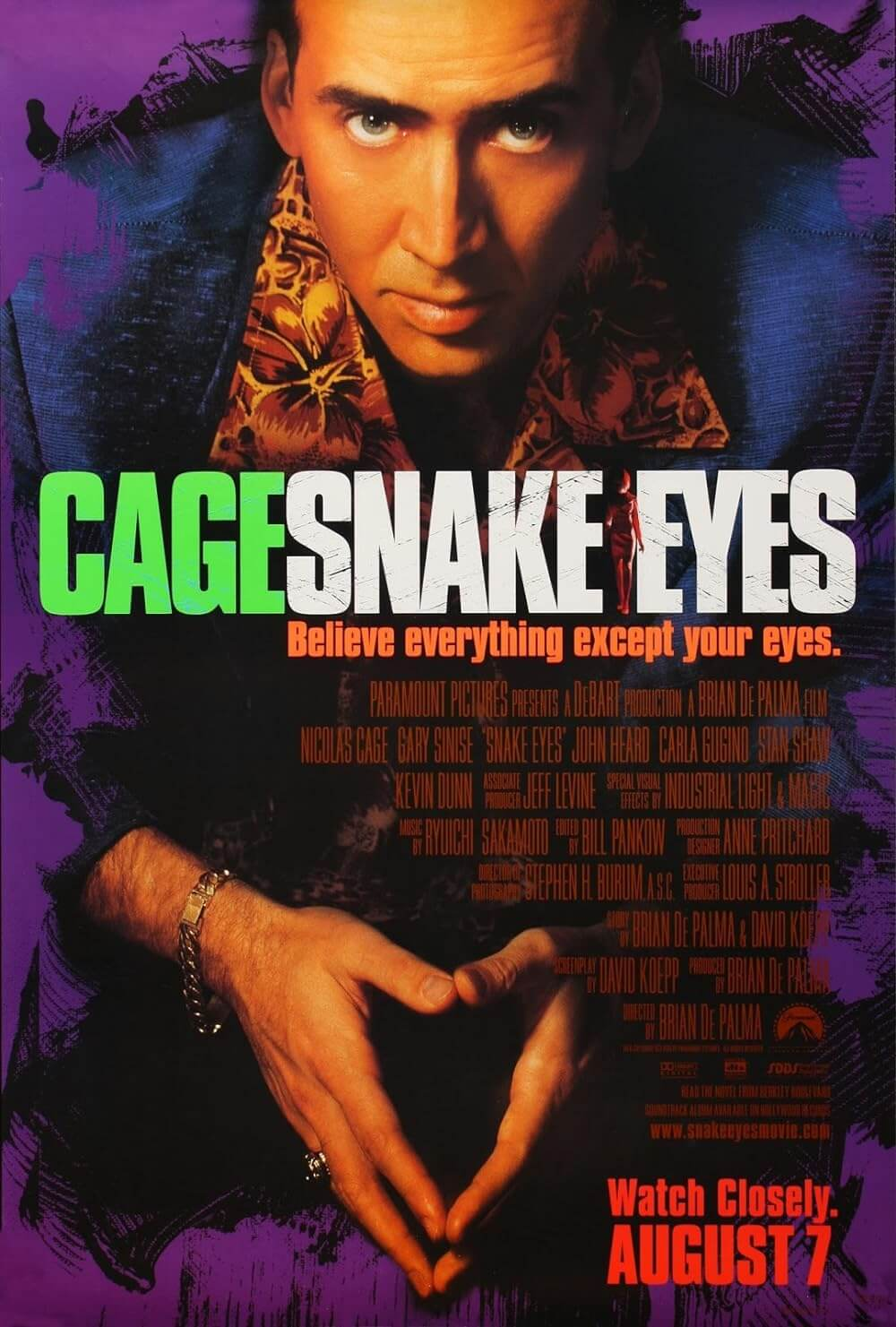
Even the movie poster has been given scrutiny:


Setting aside how suggestive the tagline is, you notice his hands? Who else is famous for always having his hands in this pose?


Maybe it means nothing. Or maybe reality is simulated and sometimes recycles from old scripts.
In any case, this was an entertaining movie and I definitely encourage you to give it a watch. Nic Cage and Gary Sinise were both great and the not-quite-happy-ending felt accurate without taking away from also being satisfying.
Have you seen Snake Eyes? If so, what did you think?