


To view more poems I have examined, click HERE.
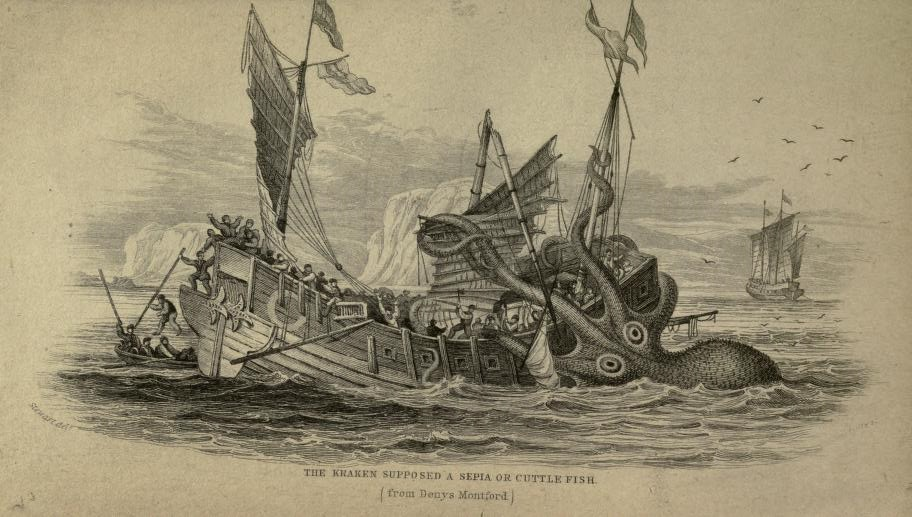
THE Kraken
by Alfred Lord Tennyson
Below the thunders of the upper deep,
Far, far beneath in the abysmal sea,
His ancient, dreamless, uninvaded sleep
The Kraken sleepeth: faintest sunlights flee
About his shadowy sides; above him swell
Huge sponges of millennial growth and height;
And far away into the sickly light,
From many a wondrous grot and secret cell
Unnumbered and enormous polypi
Winnow with giant arms the slumbering green.
There hath he lain for ages, and will lie
Battening upon huge sea worms in his sleep,
Until the latter fire shall heat the deep;
Then once by man and angels to be seen,
In roaring he shall rise and on the surface die.
_______________________________

The Kraken is a 15 line poem. All the lines are in one stanza. The rhyme scheme is unusual, consisting of ABAB CDDC EFEAAFE. The meter is also unusual in its inconsistency. The first four lines are in iambic pentameter. Lines 5 and 6 add a half-beat to the first four and consist of eleven syllables. Line 7 returns to iambic petameter and Line 8 adds back the half-beat of lines 5 and 6. Lines 9, 11, 13 and 14 are in iambic pentameter. Lines 10 and 12 contain eleven syllables. The final line breaks with all that came before it and is written in twelve syllables.
The inconsistency in the meter gives the poem a feel of song.
The poem describes an ancient sea monster, lying dormant and asleep in the deepest parts of the ocean. The poet describes it, and the life that passes around it, until telling us that at the end of time, it will rise to the surface, unleashing its full power and that when it does so it will die. The Kraken thus seems to be a religious metaphor.
Lines 1 – 4:
Below the thunders of the upper deep,
Far, far beneath in the abysmal sea,
His ancient, dreamless, uninvaded sleep
The Kraken sleepeth: faintest sunlights flee
Here the Speaker tells us about the Kraken and where it lives (the deepest part of the ocean.) We learn that the beast is ancient and sleeping. Tennyson describes its sleep as dreamless and uninvaded, creating a sense that it does not even stir. However, by pointing the creature’s status out, the Speaker also invites wonder about a change to the status quo.
In the midway part of line 4, the Speaker begins to describe what life at the bottom of the ocean looks like.
Lines 5 – 8:
About his shadowy sides; above him swell
Huge sponges of millennial growth and height;
And far away into the sickly light,
From many a wondrous grot and secret cell
The Speaker paints the picture of darkness and agedness. The Kraken has been so still, for so long, that many thousand year old sponges have grown all around it. It is so still and so unmoving that it has not disturbed them.
We are invited to imagine a creature, as vast as a mountain, that has been still for so long, at such a great depth, that what life exists around it thinks of it as a feature on the floor of the ocean, not as a thing that might someday awaken.
Lines 9 – 15:
Unnumbered and enormous polypi
Winnow with giant arms the slumbering green.
There hath he lain for ages, and will lie
Battening upon huge sea worms in his sleep,
Until the latter fire shall heat the deep;
Then once by man and angels to be seen,
In roaring he shall rise and on the surface die.
The Speaker continues to describe the creature in lines 9 through 12. However, in line 13, the tone changes with the use of the word “Until,” and from then forward we are told the circumstances (“the latter fire’) that will drive the creature to wakefulness once more.
There are many possible interpretations of the piece. The one that I prefer is that the Kraken is a religious metaphor for the Devil (or perhaps the antichrist) and the end of time. The Book or Revelation descries a “beast of the sea.”
Revelations 13: The dragon stood on the shore of the sea. And I saw a beast coming out of the sea. It had ten horns and seven heads, with ten crowns on its horns, and on each head a blasphemous name. 2 The beast I saw resembled a leopard, but had feet like those of a bear and a mouth like that of a lion. The dragon gave the beast his power and his throne and great authority.
It might be argued that Tennyson gives a name to the beast described therein.
Another potential interpretation of The Kraken is that it simply represents the unknown. There is mystery, and an unlimited potential power in our imaginations for all that is unknown. Of course, once we see a previously unknown thing, we come to know it. “The unknown” becomes known and as that happens, it becomes limited. The “unknown” dies and a new and defined thing takes its place.
The poem is famous and highly regarded. (via wiki)
The critic Christopher Ricks writes that it is among the best poems in the volume, all of which originate in Tennyson’s “despondency”. In “The Kraken,” writes Robert Preyer, a “very early work, one already sees a magnificent matching of the various technical components to secure an effect that is intense, strange, remote, and curiously suggestive and impersonal.”
Background and interpretations
Laurence Mazzeno’s survey finds “wildly differing interpretations.” Some critics saw the Kraken as the image of the poet, imprisoned or isolated either in the creative process or in the mind. Isobel Armstrong read the poem politically, seeing the Kraken as representing the “slumbering political might of the working classes.”
Robert Preyer writes that the poem contains “apocalyptic shapes unseen by the ordinary person” and its “oracular voice” tells of “mindless forces” that are capable of “exploding to the surface in a burst of irrational frenzy that marks the end of its peculiar life-in-death, the end of ordinary living, and also the onset of eternity.” The poem does not offer rationalization for its vivid images: “the timeless, mythic voice giving utterance to the oracle is exactly right.”